

If you’re considering a small business loan to launch or grow your dream venture, you’ll likely need equity to support your application. But can you answer this: How does equity work? If you’re not certain, then this guide will help!
In this overview, you’ll learn how equity works, including six key points to help you prepare for the application and approval process, so you’ll be on your way to securing the funding you need.
What is owner equity for a small business loan?
As you’re researching loan options for your new or growing business, you’ll find that many loans will require “owner equity” or, simply, equity. Owner equity is an essential part of the loan process because lenders want to see that you’re financially invested in your business.
Equity typically comes from your personal funds that are contributed to the business and can be clearly documented and traced. This may include transfers from personal savings into the business or funds accessed through sources such as a home equity line of credit.
It’s important to know that some business expenses you’ve already paid may also count toward the equity requirement.
How does equity work on a small business loan?
Lenders don’t just look at how much equity you’re contributing – they also look closely at where it came from and whether it can be verified.
Here are the six key points you should know:
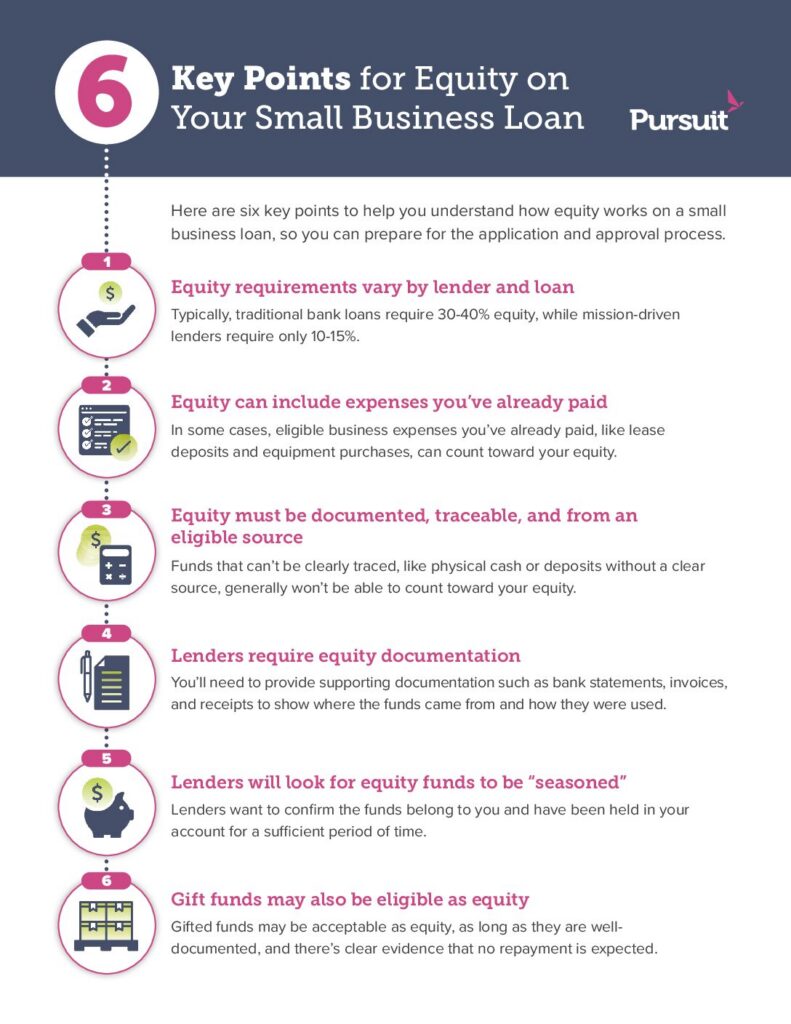
1. Equity requirements vary by lender and loan
Your equity requirements will vary by lender and loan type, so it’s important to do your research before applying. Nonprofit and mission-driven lenders typically require 10% equity of the total loan amount (some may require up to 15%). Compared to traditional bank loans, which may require up to 30-40% equity, this can be much more manageable.
Equity requirements can also vary by specific loan programs. For example, the U.S. Small Business Administration (SBA) sets different requirements for its loans, like SBA 504 loan equity requirements slightly differ from those for an SBA 7(a) loan.
You may also find a “no money down” option, and if you do, research those carefully. Some lenders and loans may offer difficult and predatory terms, such as daily payments or high interest rates. Before agreeing to this kind of financing, it’s a good idea to ask your accountant or other financial advisor to review this option.
2. Equity can include expenses you’ve already paid
Equity isn’t limited to funds sitting in your account. In many cases, eligible business expenses you’ve already paid can count toward your equity requirement if they’re directly related to the project and fully documented.
Some examples include lease deposits, equipment purchases, and startup costs paid using your personal funds. To be considered, these expenses must have a clear paper trail showing where the funds came from and how they were used.
It’s important to note that not all expenses will qualify – costs that can’t be documented, aren’t tied to the business, or can’t be traced, typically can’t be counted toward your equity.
3. Equity must be documented, traceable, and from an eligible source to be approved
Keeping good records of all transactions related to your business is important for many reasons, from ensuring accurate tax filings to helping you provide proof of eligible expenses toward equity requirements for a small business loan.
One of the first steps to starting a business is to open a business bank account so that your personal and business finances are clearly separated. From there, transferring funds from a personal account into the business account – and using those funds to pay for business expenses – creates a clear trail that lenders can verify.
For example, if your personal funds are used for business expenses, those funds should first be transferred into your business account, with supporting documentation such as bank statements, invoices, and receipts. Keeping these transactions recorded in your bookkeeping system can also help ensure everything ties together and can be easily verified during the loan process.
Funds that cannot be clearly traced, like physical cash or deposits without a clear source, generally won’t be able to count toward your equity requirement.
4. Lenders require equity documentation as part of the loan process
As soon as you contact a potential lender for a small business loan, they should tell you (and you should be sure to ask) what the required equity amount is for your loan and what types of contributions may be acceptable.
If you contribute personal funds, whether held in an account or already used for eligible business expenses, you’ll need to provide supporting documentation such as bank statements, invoices, and receipts to show where the funds came from and how they were used.
Expenses may not qualify if they can’t be documented, were paid in cash without a clear financial record, or aren’t directly related to your project. Missing or unclear documentation is one of the most common reasons loans are delayed during underwriting or closing.
Maintaining clear financial records helps lenders verify the source and availability of funds for your project and can help prevent delays during underwriting or loan closing.
5. Lenders will look for equity funds to be “seasoned”
Seasoned funds are funds that have been in your personal account long enough for lenders to verify their source. Lenders typically review bank statements to confirm the funds belong to you and are not newly borrowed or from an undisclosed source.
Lenders will also review statements to confirm the funds have been held in your account (or another documented source) for a sufficient period of time and are available for or have been used toward eligible project-related expenses.
6. Gift funds may also be eligible as equity
In some cases, funds gifted from family members or friends may be acceptable, as long as they are properly documented and there’s clear evidence that no repayment is expected.
Gifted funds should be supported by a signed gift letter stating that the funds are not borrowed and don’t need to be repaid.
An example of using equity for a small business loan
Let’s say you start a plumbing business working out of your home, but as it grows, you know you’ll need a stand-alone space, a truck, additional equipment, and funding. You update your business plan and financial projections to reflect your strategy and determine that you’ll need a $50,000 loan to achieve your goals:
- As you research financing options, you find a building that’s perfect for your business. You sign a three-year lease that requires a security deposit and the equivalent of two months’ rent, totaling $3,600, which you pay by writing a check from your personal account to your business. Then, you write a check to the landlord from your business checking account.
- You also purchased office equipment and software programs, totaling $900. You pay for these expenses using your business’s checking account.
- After meeting with several lenders, you decide to go with a nonprofit lender offering small business loans in your area. The lender told you that for a $50,000 loan, you would need to provide 10% equity, or $5,000.
- During the underwriting process, you are able to show that the lease you signed was for the business and that the payment was made using funds transferred from your personal account into your business account. Your bank statements, the canceled check, and the lease documents all support the source and use of funds.
You also provide invoices for the office equipment and software, along with proof that these expenses were paid from your business account and were necessary to support your growth. - Your lender verifies the documentation and approves using these expenses toward the 10% equity requirement. Then, you provide the remaining $500 of owner equity, which is available in your personal savings account.
Further documentation, including bank statements, show these funds have been in your account and available as equity for over 60 days, which is your lender’s seasoned requirement.
With these approved eligible equity contributions, you’re able to secure the financing you need to move forward with your plans.
When you need small business financing, Pursuit can help
Pursuit has helped thousands of small business owners get the financing they need to succeed, and we can help you, too.
As a leading small business lender serving businesses across New York, New Jersey, Pennsylvania, Connecticut, Illinois, and Delaware, we offer loans and a line of credit from $10,000 to $5.5 million for working capital, commercial real estate, equipment, and much more.
Our team can help you identify eligible expenses that may reduce the amount of cash you need to meet the equity requirement. We also provide information and resources that can help you create a path to success.
Contact us today to learn more!