

The right financing can make a world of difference for your small business, allowing you to smooth out cash flow cycles, purchase equipment, expand, hire, and more. The key is to determine whether you’re ready to take on business debt for your business and goals.
In this overview, you’ll learn how to determine if your business is ready for business debt. You’ll also explore key insights into funding options so that, if you move forward with financing, you can avoid potential pitfalls and secure a loan or line of credit that supports your success.
Are you ready for small business debt?
While the right small business financing can be a huge boost for your small business, it’s important to know if you’re ready to take on business debt.
It’s also important to know that getting approved for a loan or line of credit isn’t a matter of luck – it’s a matter of planning, preparation, and setting the right intentions and goals.
Here’s a list to help you determine readiness and prepare for the application and approval process, including ways to access the most affordable and beneficial financing.
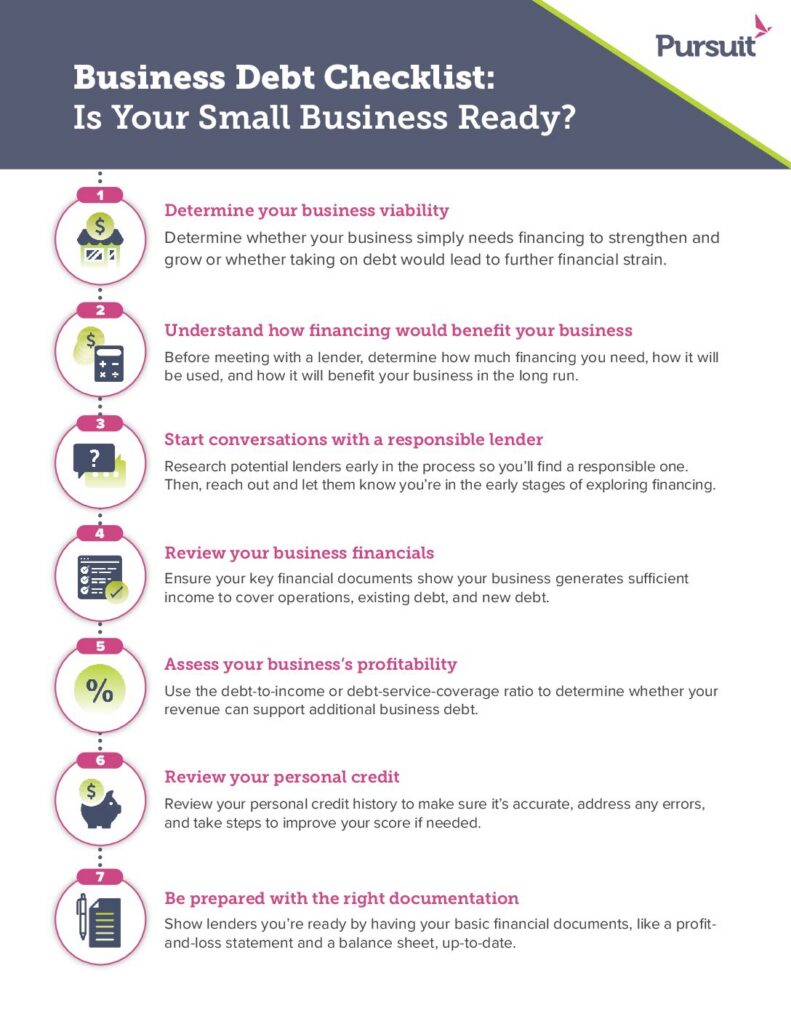
1. Determine your business viability
Every small business struggles from time to time, but some businesses simply aren’t viable – they are unable to overcome occasional slowdowns and challenges, and establish long-term financial health.
Before you move forward with new business debt, review your business viability to determine whether your business simply needs financing to strengthen and grow or whether taking on debt would lead to further financial strain.
2. Understand how financing would benefit your business
Before meeting with a lender, you should determine how much financing you need, how it will be used, and how it will benefit your business in the long run. For example, if you need funding to buy additional equipment, show how this meets your goals and will boost profitability by building efficiency and capacity. When you’re clear on your business plan, it will be much easier for a lender to understand your needs and goals, too.
3. Start conversations with a responsible lender
By researching potential lenders early in the financing process, you stand a better chance of finding a responsible lender to help you. Once you find one, reach out and let them know you’re in the early stages of considering funding. They’ll let you know the financial documents to prepare and can help you find financing options that will meet your needs.
In addition to banks and credit unions, there are small business lenders, like Community Development Financial Institutions (CDFIs) and Certified Development Companies (CDC), that have been approved by the U.S. Small Business Administration (SBA) to help small businesses. However, there are predatory lenders that will loan you money, but often at a high cost – very high interest rates or accelerated and unreasonable repayment terms like daily payments.
4. Review your business’s financials
It’s a good idea to review your key financial documents to ensure your business generates sufficient income to cover existing operations, any outstanding debt obligations, and new business debt, while meeting a lender’s debt ratios.
In some cases, a lender will work with you to refinance existing business debt that may be straining your cash flow, so if you’re in this situation, it’s worth a conversation to see if you can access more favorable terms.
5. Assess your business’s current profitability
A lender will calculate a debt-to-income or debt-service-coverage ratio (DCSR) when determining whether your revenue can support additional business debt. You can calculate it, and potentially improve it, before going through the application process.
If your business’s current ratio falls outside a reasonable approval range, there are steps you can take to improve it before applying. Typically calculated annually, the higher this ratio is above 1.0, the more debt your business can afford. If the ratio is close to or less than 1.0, your business is at risk of not being able to afford its existing debt payments.
6. Review your personal credit
Lenders will review your personal credit history as a way of gauging your capacity to take on and manage debt. That’s why it’s essential to review your personal credit history, ensure it’s correct, and identify and address any errors.
It’s important to know that while banks and credit unions have stricter criteria regarding credit scores, CDFIs have more flexible lending criteria, so even if your credit score isn’t ‘Excellent,’ it’s worth a conversation.
7. Be prepared with the right documentation
The goal is to know what you’ll need to have ready before you apply, because it will be hard to justify that your business is ready for financing if you don’t have the required financial statements.
Talk to your lender to learn about the required documents and be ready to provide these common items:
- Your past year’s filed tax returns.
- A recent profit-and-loss statement and balance sheet.
- Quotes or order forms for equipment that you’re looking to finance.
- Financial projections and business plans may also be required.
If you haven’t launched your business yet and you need startup financing, working with your local Small Business Development Center (SBDC) or SCORE mentors can help. As non-profit business support organizations, most of their offerings are available at no cost. They can help you create a sound business plan and realistic financial projections, and support you at any stage of business growth. Be sure to reach out for their insight and guidance!
Now that you’re ready to take on business debt, how do you find the right small business funding? There are many great small business financing options available to meet a wide range of needs. That’s why it’s important to plan ahead, know your options, and explore them with experienced and responsible small business lenders.
How to find the right small business financing
Here are some popular financing options to consider:
- Small business line of credit: These can be ideal when your business needs short-term financing to cover immediate needs or leverage opportunities.
- Smaller business loans: These are excellent options when you need a financial boost to help smooth cash flow, purchase equipment, stock up on inventory, bring in seasonal staff, or similar expenses. For example, the SBA Microloan offers financing from $10,000 to $50,000.
- Higher-limit loan options: For example, the SBA 7(a) and SBA 504 loan programs that offer financing up to $5 million for a range of higher-cost needs, including purchasing a franchise or existing business, buying, renovating, or constructing commercial property, major equipment, and more.
These types of small business financing can be essential for maintaining day-to-day financial stability and leveraging new opportunities, whether you’re expanding current operations, adding new locations, or acquiring competitors.
Pursuit: The right lender for small business success
If you have a business in New York, New Jersey, Pennsylvania, Connecticut, Illinois, or Delaware and you’re considering taking on business debt to support stability and growth, we can help.
Pursuit is a leading small business lender offering more than 15 loans and a line of credit for working capital, commercial real estate, equipment, and more for a wide range of uses in most industries.
We’ve helped thousands of small business owners get the funding they need to achieve their goals and build the businesses of their dreams, and we can help you, too!