
The rise of artificial intelligence (AI) is changing a lot about how you work, create, and find information online. As more people turn to AI-powered tools to answer questions and discover solutions, it’s essential that your business can be found, understood, and trusted by AI systems. But how do you do that? With your AI search optimization strategy!
In this overview, you’ll explore how AI is reshaping search, the key differences between traditional and AI-search, and strategies you can implement to improve your AI search results.
What is AI search optimization?
AI search optimization is the practice of making your content more likely to be found, cited, and accurately summarized by AI-powered search tools, such as Google’s AI Overviews and AI Mode, ChatGPT, Perplexity, Claude, and Copilot. It’s also called generative engine optimization (GEO), answer engine optimization (AEO), or LLM optimization (LLMO). The names differ, but the goal remains the same: to be seen and trusted by AI search engines.
To truly understand, you’ll need to know the process. Here’s how AI search works:
- First, you ask a question.
- The AI typically retrieves relevant pages from the web or a search index.
- The AI synthesizes those sources into a single answer, often citing a handful of them along the way.
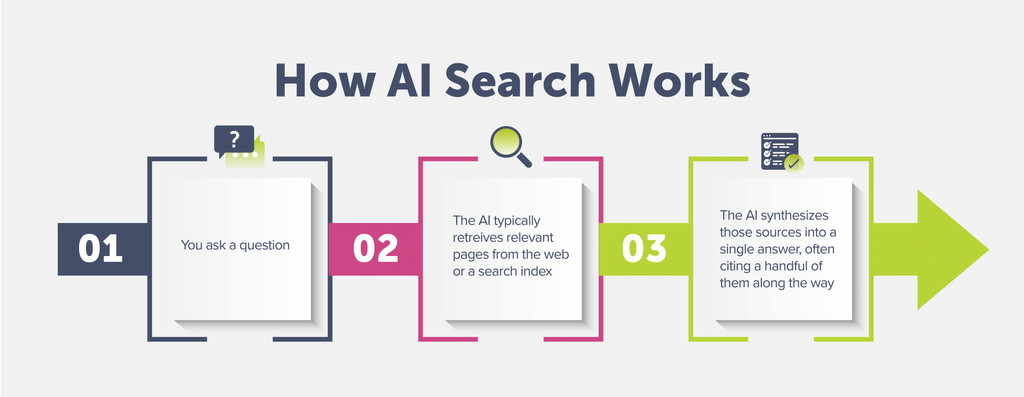
This new process changes how your business thrives in search results. In traditional search, success means ranking at the top of a list. In AI search, success means being one of the few sources the AI trusts enough to quote.
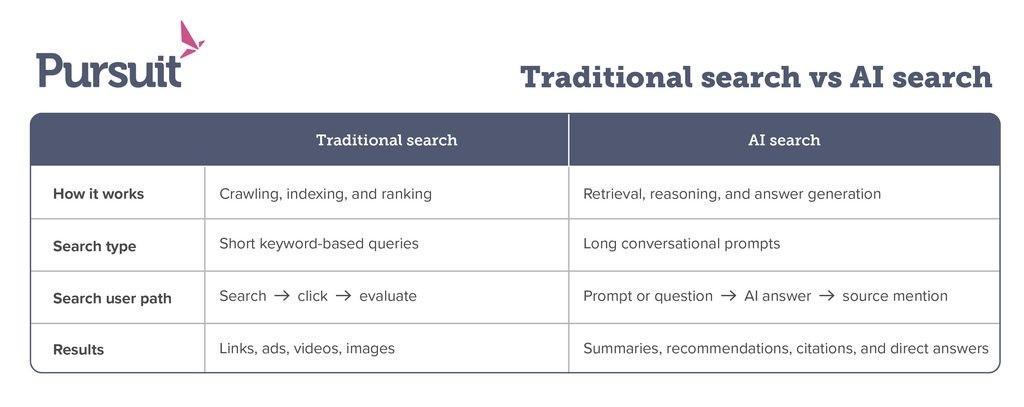
Why is AI search optimization important for your small business?
AI is increasingly becoming the top resource for search. In fact, according to a 2025 McKinsey report, 44% of AI search users say it’s their primary source for insight. This means that your customers are using AI to search for their options, and you need to make sure your products and services show up.
AI is also contributing to the rise of zero-click searches, when users search online and don’t click on a single link. In fact, according to a 2025 Pew Research survey, users are nearly twice as likely to click on a search result link if there isn’t an AI overview. This significantly impacts the way your business is seen because many users will find your information but won’t visit your website.
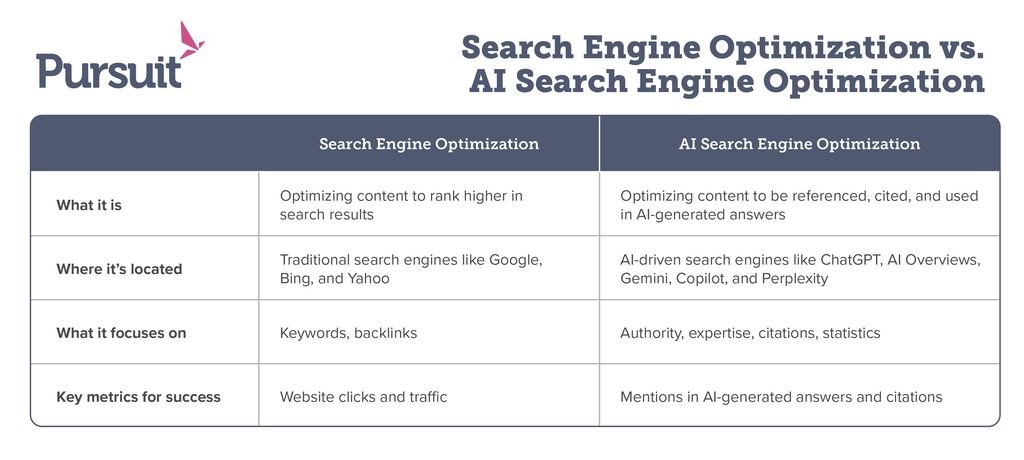
What’s the difference between AI search optimization and Search Engine Optimization (SEO)?
While Search Engine Optimization (SEO) and AI search optimization overlap, you still need both to achieve the best results. Even with AI search, there are still billions of organic search engine searches a day that you don’t want to miss out on.
AI search favors information that is easy to extract from a page, whereas SEO is more holistic and focuses heavily on backlinks. This creates a unique advantage: not only can your site appear in AI search results, but the content from your page can actually shape how AI is responding to its users’ queries.
How to optimize your business for AI
Here are the six simple strategies you can start using to optimize your website for AI:
1. Answer questions directly
AI is most likely to reference sites that directly answer the questions its users ask. AI reads writing just like people do: headlines first and then deeper dives into relevant paragraphs. As a strategy, design your content with direct answers to questions that align with what your target customers are asking as section headings, and then expand deeper in the body text.
2. Structure for AI
AI search also prefers content that is neatly packaged. If your website features content that indirectly addresses a key topic relevant to your customers, or answers it partially in different sections, it’s less likely to get picked up by AI. This is where frequently asked questions (FAQ) sections become most valuable – they provide bite-sized and complete answers to key questions that AI can extract and quote in its responses.
3. Demonstrate experience, expertise, authoritativeness, and trustworthiness (EEAT)
Just like with SEO, author bios, first-hand experience, original data, and cited sources signal trustworthiness. The good news with AI search optimization is that demonstrating EEAT is easier. With SEO, you need to demonstrate this site-wide, and that’s how search engines like Google evaluate your site ranking. With AI, you only need to show this in the passage or excerpt. By incorporating EEAT elements into a relevant section, you can add that to your page and show up more readily to AI searchers.
4. Make sure AI bots can read your content
This is a key technical strategy. Most AI bots don’t execute JavaScript and only see the initial HTML, which means that if important content is generated in the browser after the page loads, AI tools may not be able to see it. If you’re unfamiliar with these technical aspects, reach out to your developer and explain that you want your website to be readable by AI bots that aren’t executing JavaScript.
5. Avoid keyword stuffing
Keyword stuffing was a key SEO practice for years, but repeating target phrases doesn’t help with AI engines and can actively hurt. In fact, according to a Princeton GEO study, keyword stuffing scored 8% below the performance with no optimizations, making it one of the few tactics that performed worse than doing nothing. AI models evaluate meaning and clarity, not term frequency, so stuffed prose comes off as lower quality.
6. Keep brand information updated and consistent
If your pricing, product details, or business facts differ across your website, review sites, social profiles, and old press coverage, AI engines may repeat outdated information or cite a competitor instead. Similarly, updating a page’s date without updating its content is an empty freshness signal. Be sure to refresh the actual statistics and examples.
Adapting your business for AI search
AI search is rapidly changing, so the most important advice is not to let your website go stale. Make it a habit to refresh content on your website every one or two months, and make sure information like your pricing is consistent on your site with other platforms you sell on. This is a new field, which presents challenges, but also great opportunities for your small business to be seen.
Pursuit can help your business reach new heights
Getting your business seen is just one step, you also need the funding and support to keep your business moving forward. If you need financing to launch or grow your small business, to help optimize for AI, or to leverage other opportunities, Pursuit can help!
We’re a leading small business lender with loans from $10,000 to $5.5 million and we can help you secure financing for working capital, equipment, the purchase or construction of commercial real estate, to refinance business debt, and more for businesses in New York, New Jersey, Pennsylvania, Connecticut, Illinois, and Delaware.
Apply today to get started!