

While entrepreneurs share several traits, there are specific skills and experiences veterans bring to small business ownership that can really set the stage for success. This includes strong leadership and communication skills, adherence to routines, and exceptional problem-solving capabilities. However, veterans may not have some of the commonalities of civilian life, like opportunities to build a personal credit history, making post-military life more challenging.
In this guide for veterans, you’ll find tips to help you strengthen your post-service personal credit profile, find useful and relevant resources, and build confidence as you pivot from military service to entrepreneurship.
Why veterans should consider business ownership
Starting and growing a successful small business takes discipline, project management, and creative problem-solving abilities. Veterans encompass these qualities along with leadership skills, tenacity, and a can-do attitude gained from their military experience.
In the U.S., there are about 1.6 million veteran-owned small businesses that:
- Employ 3.3 million workers
- Generate nearly $984 billion in revenue annually
- Operate in a huge range of industries, including professional services, construction, logistics, project management, and utilities
Owning a small business also offers opportunities to be your own boss, create the business of your dreams, and work in a field and on a schedule that suits your professional and personal interests and goals.
Why does personal credit history matter for business ownership?
Your personal credit history is a significant factor in securing affordable small business financing. When a lender reviews your loan application, your personal credit score provides a more accurate picture of your ability to pay back your debts, especially if your business hasn’t launched or is newer and hasn’t established a business credit score yet.
When your lender looks at your personal credit history, they’re evaluating your credit use, your ability to pay back loans, and whether you’ve paid off previous loans and obligations. They’ll also look at how much credit you currently have (the limits, as well as how much you’re using) and whether your payments are made on time.
These criteria are commonly known as the 5 C’s of Credit: character, capacity, capital, collateral, and conditions. Lenders consider these factors, along with your personal and business credit history, when evaluating your loan application.
While personal credit is important, lenders also consider the bigger picture too. This can include your cash flow, existing debt, experience, capital, collateral, business plan, and financial projections.
How to overcome credit challenges following military service
Along with common financial challenges, veterans sometimes face additional hurdles that can impact your personal credit score. For example, deployments or geographic relocation can result in an insufficient credit history or missed payments.
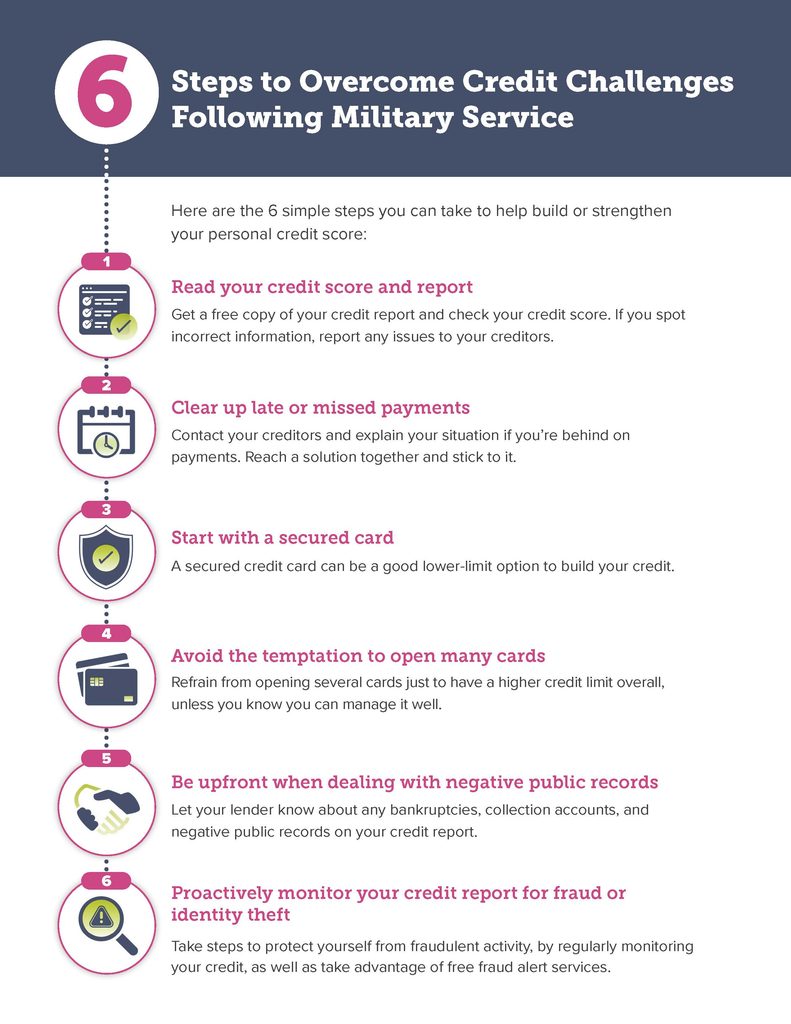
Veterans are no strangers to challenges, though, and overcoming credit issues isn’t difficult, as long as you’re consistent and patient with yourself and the process. Here are proven steps that can help you build or strengthen your personal credit score and begin to see positive changes soon – often, within a matter of weeks or months:
1. Read your credit score and report
Your credit report contains information about your credit accounts, payment history, and other credit-related activity, while your credit score is a numerical calculation based on information in your credit report. Lenders may consider both when evaluating your application.
Get a free copy of your credit report and review it for errors. You can also check your credit score and other information for free on websites like CreditKarma. If you spot incorrect information, report any issues to your creditors. It can take some time to correct credit report errors, and the sooner they’re cleared, the sooner your score will improve.
2. Clear up late or missed payments
If your report shows that you’re behind on payments, contact your creditors and explain your situation. Often, they’re willing to work with people who take responsibility, especially when your challenges may have been related to your military service. Reach a solution together, then stick with the plan.
A good strategy to get back on top of your payments is to set up automatic payments for the minimum due each month (although it’s always best to pay in full, if possible, to reduce interest charges and overall debt).
3. Start with a secured card
If you don’t have a credit history because you’ve been deployed, have avoided using credit in the past, or have had credit suspended due to missed payments, a secured credit card can help. These are often available through banks and credit unions. They have a lower limit, such as $300-$500, and you keep that amount on deposit with the creditor while still using and paying off your balance each month.
For example, if you have a secured card and spend $100 monthly that you pay off in full, that will help you build your history. And, if you miss a payment, your creditor has the funds on deposit to draw from (but try not to do that, as the point is to build a good credit history).
4. Avoid the temptation to open many cards
While responsibly managing several types of debt can reflect well on your credit history, don’t open several cards just to have a higher credit limit overall, unless you know that you can manage that well. Otherwise, this can trap you in financial challenges, such as job loss, because you end up with more debt than you can pay off each month.
5. Be upfront when dealing with negative public records
When a lender sees bankruptcies, collection accounts, and negative public records on your credit report, it may be a red flag if they don’t know the full story. These could be due to deployment, relocation, injury, or illness. A bankruptcy won’t necessarily disqualify you from getting a business loan, but if you’ve experienced financial issues, you may have fewer loan options.
6. Proactively monitor your credit report for fraud or identity theft
Identity theft and credit fraud are concerns for both individuals and businesses. If you’re proactively monitoring your credit, you’ll be able to catch fraud or identify theft quickly and clear the errors.
It’s also a good idea to take steps to protect yourself before any fraudulent activity can happen. Take advantage of free fraud alert services offered by the three major credit reporting agencies (Experian, Equifax, Transunion). These services can help notify you if they spot suspicious activity or if someone tries to access your credit records without your permission.
The Servicemembers Civil Relief Act (SCRA) was passed to help service members gain additional protection and help for financial and credit challenges that you may experience. If you need additional help, know that it’s there for you.
How to prepare veterans for funding
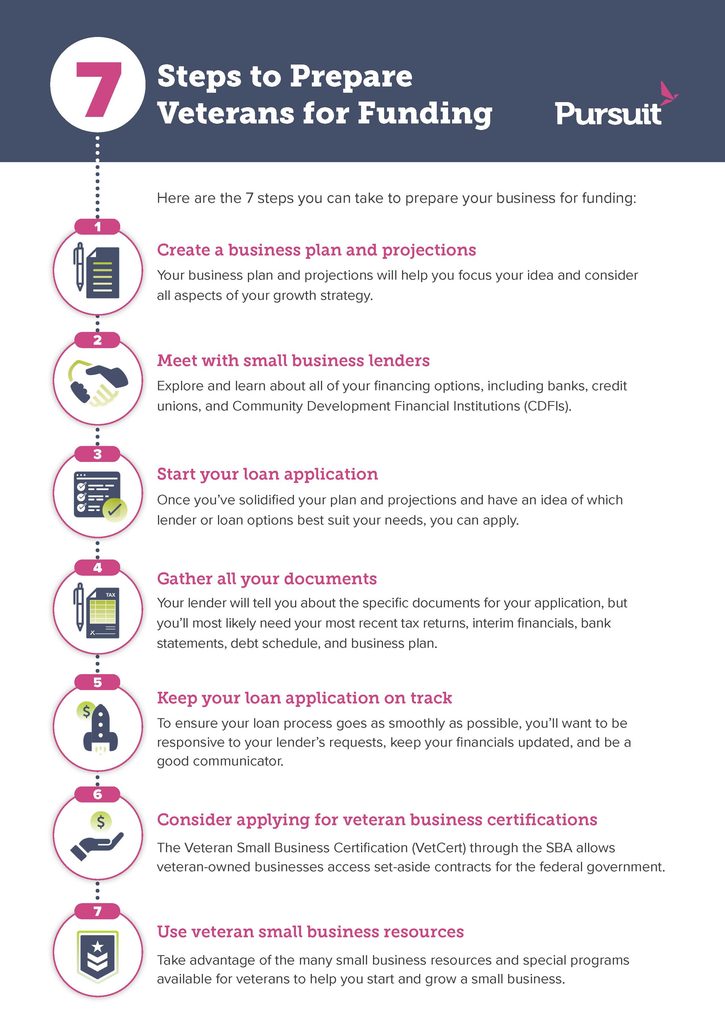
Once you’ve improved your credit score and credit history, the next steps to launch and grow your small business and access funding are:
1. Create a business plan and projections
This helps you focus your ideas, consider all aspects of your business’s growth strategy, and develop realistic financial projections. You can get free help at any Small Business Development Center, the SBA’s Veterans Business Outreach Centers, and through SCORE. The SBA’s Boots to Business program is also a great resource that provides entrepreneurial education and training to veterans.
2. Meet with small business lenders
This helps you learn about all of your financing options. In addition to banks and credit unions, you’ll find that Community Financial Development Institutions (CFDIs), like Pursuit, will have more flexible eligibility and approval criteria, along with outstanding loan options that help you launch and grow.
It’s a great idea to do this step as you’re developing your business plan and projections, because early conversations will help you learn about different loan options, and that may impact some of your decisions.
3. Start your loan application
Once you’ve solidified your plan and projections and have an idea of which lender and/or loan options best suit your needs, you can apply.
4. Gather all your documents
As part of the application process, there are several documents that you’ll need. Your lender will tell you about the specific documents for your application, and these may vary based on your business and whether you’re in the pre-launch, startup, or expansion phase. In general, you’ll need your most recent tax returns, interim financials, bank statements, business debt schedule, and a business plan.
5. Keep your loan application on track
To ensure that your loan process goes as smoothly as possible, you’ll want to be responsive to your lender’s requests, keep your financials updated, and be a good communicator.
6. Consider applying for veteran business certifications
The Veteran Small Business Certification (VetCert) through the SBA allows Veteran-Owned Small Businesses (VOSBs) or Service-Disabled Veteran-Owned Small Businesses (SDVOSBs) to pursue set-aside contracts for the federal government.
7. Use veteran small business resources
Take advantage of the many small business resources and special programs for veterans. You’ll find people who want to help, as well as programs that can get you on a path to post-service success. There are outstanding veteran loans and educational resources available to veteran business owners (as well as your family members) to help you start and grow a small business.
Pursuit has small business loans for veterans
At Pursuit, we have many loan options available for veterans, as well as decades of experience helping veterans transition from military service to successful business ownership. Our veteran loan program offers loans up to $250,000 at a reduced and fixed interest rate.
If you have a business in New York, New Jersey, Pennsylvania, Connecticut, Illinois, or Delaware and you’re considering applying for a small business loan, Pursuit can help.