

This is a guest post written by Katy Caspersen, Operations Manager at Tetra Tech.
When you’re planning a construction or renovation project for your business, there are plenty of decisions you’ll need to make. From finalizing designs to securing financing and setting timelines, planning ahead goes a long way for a successful project. Before any work begins, one of the most important steps you need to take is finding a contractor. With the right contractor for your project, you can focus on what’s needed to grow your business.
In this overview, you’ll learn key factors to consider when choosing a contractor, strategies to manage your risk, and more.
Why it’s important to choose the right contractor
As with any major decision you’ll make for your business, doing your research and being diligent in your decision-making reduces your risk, keeps costs lower, and gives you the best chance at success.
Choosing a contractor is one of those big decisions where you’ll want to take your time. It’s important to review a contractor’s qualifications, financial stability, licensing, team structure, labor strategy, and experience so you have a good idea of what to expect when working with them.
Even a well‑financed, well‑designed project can struggle with the wrong contractor. A thoughtful, thorough selection process will reduce your risk from the start, giving your project a stronger, more stable foundation before work even begins.
What should you consider before choosing a contractor?
When choosing a contractor, having the right information up front can save you a lot of time and stress. You can request the AIA A305 contractor qualification statement from potential contractors to see and verify their information and perform your own additional research. Here’s what you’ll want to know before making your decision:
8 areas to consider when choosing a contractor
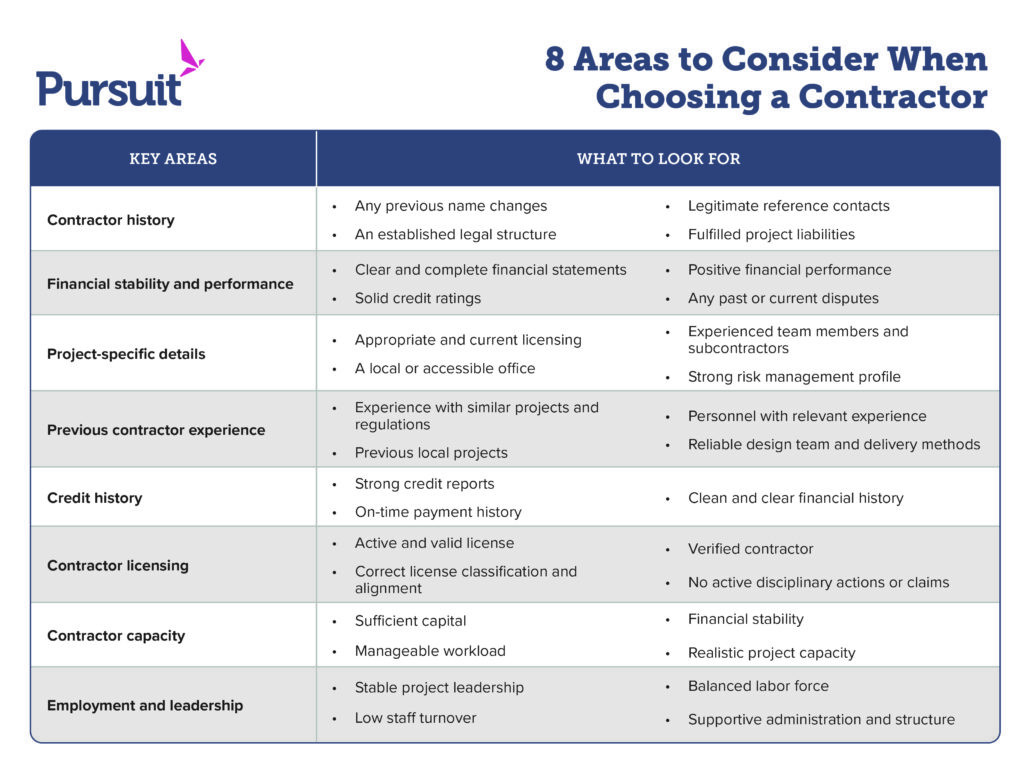
AIA A305 contractor qualification statement
Let’s start with the sections of this document to guide your assessment. Each section is listed as an “exhibit” and each exhibit is specified in the list below.
1. Contractor history
Exhibit A covers the basics of the contractor’s business, including its legal name, any prior names, legal structure, and reference contacts. These details show how established the business is and how it’s organized. You can also see if it’s had any name changes that could be from restructuring or previous issues.
What to look for:
- Any previous business names: While name changes aren’t always negative, frequent or unexplained name changes may require a closer look. Check for any name changes and ask the contractor for the reasons behind them.
- An established legal structure: Review and identify the organization structure. A contractor should be able to provide a well-defined organizational structure that is consistent across all the projects they work on.
- Legitimate reference contacts: Contact references and confirm they are real, responsive, and relevant to your project needs.
- Fulfilled project liabilities: Using the contractor’s legal name, you can identify whether they have any project liabilities that haven’t been covered.
2. Financial stability and performance
Exhibit B focuses on the contractor’s financial performance. In this section, contractors disclose financial statements, credit ratings, the status of current and past disputes, and any disciplinary actions. This gives you insight into the contractor’s financial stability and how they have managed conflicts or economic stress.
What to look for:
- Clear and complete financial statements: Review the contractor’s balance sheets, income statements, and cash flow statements to determine the contractor’s overall financial health and stability. Make sure to check for any bankruptcies, tax liens, or judgments.
- Solid credit ratings: With strong credit ratings, generally within the 670–850 range, a contractor demonstrates reliable payment habits and financial management.
- Positive financial performance: It’s a good sign if the contractor has steady revenue, healthy cash reserves, and positive year-over-year trends.
- Any past or current disputes: Disputes are disagreements or conflicts between a subcontractor and the general contractor. They aren’t always a red flag, but you should review frequent claims, unresolved disputes, and disciplinary actions, and see how each was resolved.
3. Project-specific details
Exhibit C goes into the details specific to your project, which is one of the most important factors to review. It includes licensing, office location, key team members, subcontractors, and what work they’ll perform, along with safety data, insurance limits, and bonding capacity. Together, this information helps you determine whether the contractor meets compliance requirements and matches your project’s needs.
What to look for:
- Appropriate and current licensing: Reach out to your municipality to confirm the contractor holds the correct licensing for your project and ensure that it’s active and up-to-date.
- A local or accessible office location: If a contractor isn’t located in your area, it may lead to slower response times, less accessibility, and less familiarity with local codes.
- Experienced team members and subcontractors: Ensure the key team members assigned to your project have successfully worked on and completed projects similar to yours, and that subcontractors are qualified for your project type.
- Strong risk management profile: Make sure your contractor includes information that provides reliable safety data, adequate insurance limits, and sufficient bonding capacity, so they can protect your project if something unexpected occurs.
4. Previous contractor experience
Exhibits D and E cover the contractor’s relevant experience, including past locations, project types, design‑team histories, delivery methods, and key personnel. This can help you understand and identify the contractor’s capabilities and how they align with your project. Contractors with experience in similar regulatory environments, budgets, and delivery structures are often better positioned to complete your project efficiently and predictably.
What to look for:
- Experience with similar projects and regulations: Make sure the contractor has completed projects that match your size, scope, industry, and compliance requirements.
- Previous local projects: It’s good to have a contractor who’s performed other projects near you so they’re familiar with the local jurisdictions, inspectors, and permitting processes. When a contractor is familiar with the area, it can reduce delays.
- Personnel with relevant experience: Look for project leads and key team members who have hands-on experience with projects like yours.
- Reliable design team and delivery methods: With the same design teams and effective delivery methods, the contractor is more likely to deliver predictable and efficient results.
Additional contractor information to review
While the contractor qualification statement is a great start, you should also do some research on your own while choosing a contractor for your project. Here are a few areas to look into:
5. Credit history
Take time to review the commercial credit reports from industry-specific and national bureaus. These reports show a contractor’s commercial credit activity, typical balances, payment habits, and late payment frequency.
Public records can also provide additional information, including bankruptcies, tax liens, judgments, and lien history. While a contractor may have strong technical skills, frequent liens or late payments can pose risks, like delays, subcontractor turnover, and increased claims risk.
This information can show you whether the contractor can meet their financial obligations and keep your project moving forward without delays.
What to look for:
- Strong credit reports: Look for strong credit ratings and a solid history of managing credit responsibly.
- On-time payment history: A contractor with a positive track record of making payments on time is more likely to be reliable.
- Clean and clear financial history: You’ll want a contractor with no (or very limited) history of bankruptcies, liens (including tax liens), judgments, or other financial issues.
6. Contractor licensing
Contractor licensing may seem like a simple compliance check, but it’s deeper than that. If there’s a mismatch between the licensing authority and your project scope, you can have an issue before work even begins.
States classify contractor licenses by specialty: general contractor, electrical, mechanical, plumbing, and hazardous material specialties. They also set restrictions on height, occupancy, and construction type.
In your review, confirm that the contractor’s license is active, current, and that they don’t have disciplinary actions or claims against them. You should also verify the qualifying individual – the person whose credentials support the license – and ensure the credentials align with the contractor performing the work.
If the license class or limits don’t match your proposed scope, you could have issues during plan review, inspection, or insurance, creating delays.
What to look for:
- Active and valid license: Confirm the contractor’s license is current and in good standing with your municipality.
- Correct license classification and alignment: Make sure the license matches and covers the type of work your project requires.
- Verified contractor: Review the license credentials from the AIA A305 contractor qualification statement and ensure the credentials match the contractor performing the work.
- No active disciplinary actions or claims: Check for any past or ongoing violations that could show performance or compliance issues.
7. Contractor capacity
Reviewing a contractor’s financials can also show you whether they can realistically support your project. Your contractor should have enough funds to start the job and secure materials without relying on upfront payments or advances from you.
You should also consider how the contractor’s other ongoing projects may impact yours. When a contractor is financially stable, they can handle delays or disputes from other projects without taking away resources from your project.
As an example, if a contractor typically completes $2 million projects but bids on a $15 million project, they may be stretching beyond their capacity.
What to look for:
- Sufficient capital: Make sure the contractor has enough funds to start your project without requiring additional deposits or payments. This can be determined by a conversation between you and the contractor, as well as recent bank statements.
- Manageable workload: A contractor’s existing and new projects shouldn’t interfere with your project timeline. Asking for and reaching out to references is the best way to determine what projects they’re currently managing.
- Financial stability: A contractor should be able to financially support any delays or disputes that come up without impacting your project.
- Realistic project capacity: Ensure the size and scope of your project aligns with projects the contractor typically manages.
8. Employment and leadership
Your project’s success depends heavily on leadership at the actual project site. When reviewing a contractor, consider whether their superintendents and construction managers are long‑term or short‑term employees. With permanent staff, a contractor has more stability and consistency. If they have frequent staff turnover, there may be bigger operational or financial challenges.
Administrative support from your contractor is also crucial. Construction projects rely on detailed accounting, cost coding, lien waivers, and payment processing. Contractors with experienced in‑house accounting teams can reduce delays, improve accuracy, and keep projects in compliance. A balanced labor force (including general trades, specialty trades, and vetted casual labor) allows contractors to adapt to changes without sacrificing quality.
What to look for:
- Stable project leadership: Look for long-term superintendents and construction managers for consistency and experience. You can simply ask a contractor who will be your superintendent, and how long they have worked with them.
- Low staff turnover: If a contractor has frequent turnover, it could be a sign that there are deeper operational or financial issues.
- Balanced labor force: A mix of general trades, specialty trades, and vetted casual labor allows a contractor to adapt to project changes without compromising the project.
- Supportive administration and structure: Contractors with experienced in-house teams and clear internal processes can reduce delays, improve accuracy, and keep the project running smoothly.
Do I need a formal review process to hire a contractor I know?
If you’re considering internal teams, friends, or family connections, the process may become informal. However, you don’t have less risk simply because you know the contractor. Make sure they have relevant contracting experience, proper licensing, financial capacity, and are aligned with market standards. Before you decide, determine whether the benefit of an internal relationship outweighs the benefits offered by an outside contractor.
Pursuit can help you get the funding you need
If you need funding for your project or other business needs, such as working capital, commercial real estate, equipment, and more, Pursuit can help!
Every day, we help small business owners find the funding they need to launch and grow their businesses, and we can help you, too. Let’s work together to find the funding you need to reach your goals.
Apply today to get started!