

It’s almost impossible to run a small business without technology. From your website, social media channels, and bookkeeping programs to complex services for inventory management, financial transactions, and human resources, technology is in nearly every aspect of your business operations. With this comes increased risk to your systems, but many entrepreneurs don’t realize how critical cybersecurity for business has become.
In this guide, you’ll learn why cybersecurity for business must be a part of your operations and how you can evaluate current security measures, improve them, and stay ahead of risks. This is especially important because the evolution and widespread availability of artificial intelligence (AI) has made it easier than ever for systems to get hacked and corrupted.
Why is cybersecurity important for small businesses?
While cybersecurity has long been an issue for small businesses, it’s often overlooked. That’s because it was more “worthwhile” for hackers to focus their time and energy on major corporations and government agencies. This was simply a matter of scale: Hacking was complex, but the potential payoff from a global powerhouse or government agency made the risk worth it.
With AI programs, it makes it easier to find and exploit security weaknesses, making all small businesses more vulnerable to attack. In fact, small and medium-sized businesses experienced 4 times as many cyber breaches as large organizations in 2025, with a 340% surge in AI-powered attacks.
There are also criminal hackers who offer “cybercrime as a service.” That means that just about anyone with malicious intent can find and hire an anonymous hacker via the dark web, pay them in an untraceable way (like cryptocurrency), and wreak havoc.
While this new reality is enough to give any small business owner a headache, the importance of this issue goes beyond your business’s operational health. You also need to protect the privacy and security information that your customers, employees, and vendors have entrusted to you.
Along with the types of information you have in your system are various security and compliance regulations that you must follow. If you’re not sure what they are for your business, speak with an attorney who specializes in small business and compliance.
How to protect your technology systems
There’s no one-size-fits-all solution to cybersecurity for business, but there are essential steps that all small businesses should take to protect operations, customers, vendors, and employees. While there are no guarantees, it’s more likely that hackers-for-hire and AI will find and exploit small businesses with outdated or minimal protections over those that have taken steps for better protection.
Here are the six key steps to protecting your business, why they matter, and actions you can take to implement or improve cybersecurity measures.
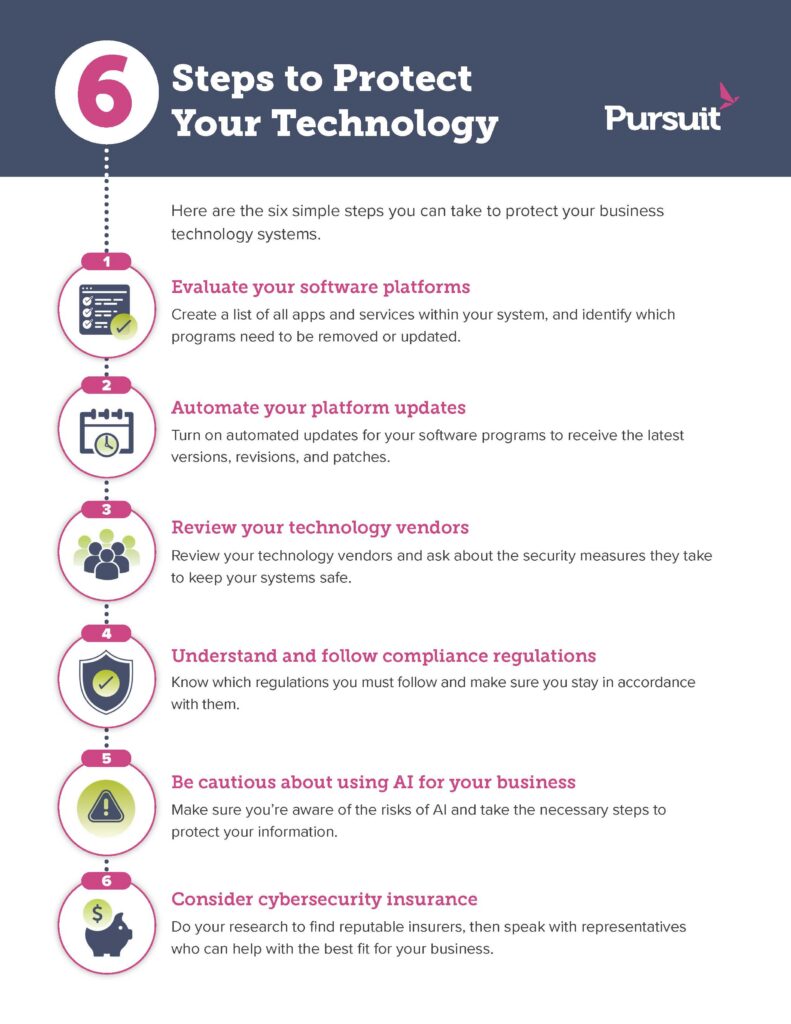
1. Evaluate your software platforms
The first step is to evaluate all the software programs your business currently uses, as well as those that may still be living in your system, even if rarely used. It’s important to:
- Thoroughly document all apps and services within your system: Depending on your business’s size and complexity, this can be a relatively brief or extensive list – and you’ll likely have more programs than you realized.
- Identify and sort the programs: Once you’ve got your list, sort the list by those programs that you know your business still uses and those that are lingering but obsolete or unused.
- Remove or update programs: You’ll want to remove the apps and programs from your system that are no longer used in any area of your business. If you’re unsure that removing unused programs could be done without impacting any of your other programs, then at the very least, be sure to install the latest updates.
For example, if you launched your business using a free version of an online bookkeeping program but have since moved to a paid subscription from another vendor, be sure to remove the old program.
2. Automate your platform updates
To keep your software programs and services as safe as possible, turn on automated updates to receive the latest versions, revisions, and patches. If you don’t already have your system set to do this, you can update these preferences through your system’s or the program’s settings. While you’re doing this, you can also update each program or app to ensure you have the latest and most secure versions.
3. Review your technology vendors
While many leading technology vendors take significant steps to prevent cyber-attacks through their services and apps, they can be targets, too. Review your tech vendors and ask about the security measures that they take to keep their clients safe.
4. Understand and follow compliance regulations
Compliance with federal and state regulations is imperative, and as a small business owner, it’s critical to know which regulations you must follow. Examples include protecting personally identifiable information (PII), such as Social Security numbers or health records, financial information, and any other information you store and use digitally.
SOC 2 (System and Organization Controls) compliance is a more rigorous evaluation of a small business’s cybersecurity program that specifies how to manage customer data and systems to ensure confidentiality, integrity, and availability. To achieve SOC 2 compliance, you’ll need to pass an independent audit showing you implemented appropriate processes to protect your systems and data. While not all small businesses may need or benefit from a SOC 2 compliance evaluation, it may be worth exploring if you provide software or other web-based services.
5. Be cautious about using AI for your business
While AI can be a great tool for streamlining tasks and providing extra support, it can also be another way for hackers to gain access to your information. If you enter proprietary information, that can be at risk, too.
AI poses many risks to small businesses, so make sure you’re aware and take the necessary steps to protect your information.
6. Consider cybersecurity insurance
Cybersecurity insurance can be a good investment. It offers some protection against lawsuits and other liabilities, though this varies by policy, industry, and other factors. Do your research to find reputable insurers, then speak with representatives who can help with the best fit for your business.
Pursuit has financing that helps strengthen small businesses
Cybersecurity for business is a serious matter, but if you take steps today to protect your business, you’ll reduce your risk. And, if you need working capital to strengthen your business’s operations, improve security, or just about any other need, contact us today.
Pursuit offers more than 15 loan programs to business owners in New York, New Jersey, Pennsylvania, Connecticut, Illinois, and Delaware. We also offer insightful resources and advisory services to help your small business get stronger today and thrive tomorrow.