

When it comes to choosing where to spend their hard-earned dollars, today, customers have more options than ever. From the vast e-commerce possibilities to increased visibility for local businesses, competition is high, and so are expectations. One way to keep customers returning and your small business growing is to clearly communicate your value proposition and, as a result, strengthen your perceived customer value.
In this overview, you’ll learn about value propositions – what they are and why they matter – and how to support yours so it can turn into positive perceived customer value and increased loyalty to your brand, products, and services.
What is a value proposition?
Your business’s value proposition is the stated (or implied) benefits that it intends to deliver to your customers. It often includes an overview of your products and services, your target audience, and the expected benefits. It’s also an opportunity to tell customers how your business stands out from competitors.
A value proposition should be clear about what’s offered, specific about key benefits, and customer-focused – all in a brief statement. Here are some examples:
- A pediatric dental practice’s value proposition may be something like “Our extra-gentle techniques take the ‘scare’ out of dental care for kids of all ages.”
- A bakery that specializes in pies may promise, “With the flakiest crust and tastiest fillings made from local produce, you will love our pies.”
- A shop focused on luxury beauty products may promise, “Only the finest skincare and haircare products, sourced directly from France for our discerning clientele.”
A value proposition can be the initial hook that gets customers interested in your business, and consistent delivery of the promise creates loyalty that includes repeat business, referrals, and positive perceived customer value – the ways customers consciously and subconsciously balance the quality and value of goods and services against the cost, convenience, and other measures.
For example, if customers believe that a bakery is living up to its value proposition, they’ll make an extra effort to get the bakery’s products – even if they cost more or if the bakery is out of the way. However, let’s say a new owner takes over, keeps the value proposition, but uses lower-quality ingredients. If that results in a decline in customer perception, it will likely lead to a loss of loyalty and sales, as it’s no longer living up to its value proposition.
How does positive perceived customer value impact your business?
When your small business has positive perceived customer value, it plays a significant role in key decisions as you strengthen and grow your business.
When customers’ expectations are met and exceeded, they are often willing to overlook other inconveniences, such as backorders and price increases, so that they can continue to receive the goods and services they’ve come to love. The importance of this can’t be overstated – especially when technology has made buying options nearly infinite, and challenges to supply chains, pricing strategies, and more have made it harder to predict the extent of brand loyalty.
It can also help you determine a path for growth, whether that means adding new in-person locations or expanding online offerings, because you have a loyal base that will help support and promote your business.
How to build customer value over time
Once you’ve developed a value proposition that’s authentic to your business and resonates with your target customers, the key is to deliver your goods and services using strategies that meet and exceed customer expectations. Doing so builds trust in your business and creates the kind of customer loyalty that makes it harder for your competitors to take.
Let’s look at the example of a pediatric dental practice’s value proposition – “Our extra-gentle techniques take the ‘scare’ out of dental care for kids of all ages.” As long as you deliver on that promise, then your clients are not only going to bring their kids, but they’ll recommend your practice to other parents for their kids – and the parents may even use your services themselves.
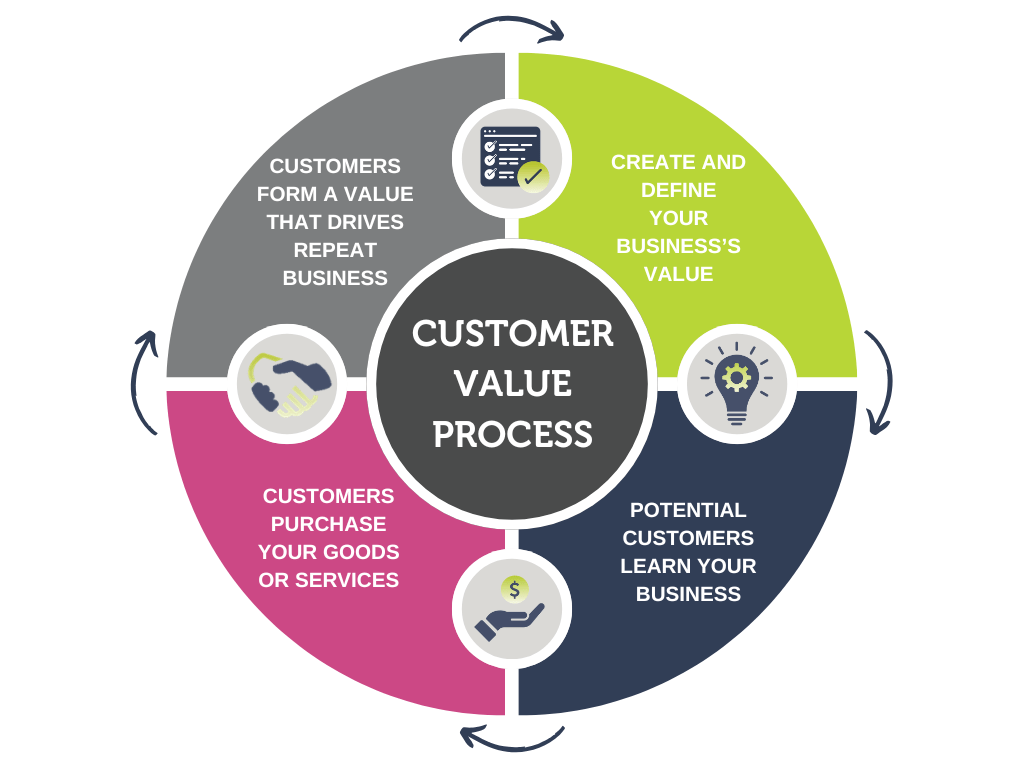
Think of the process as a circle or cycle:
- You create a value proposition that succinctly conveys your brand and business promise.
- Potential customers learn about this through your marketing, word-of-mouth, and other sources and determine whether your business is one they’d like to support.
- They purchase your goods or services and, based on how their experiences align with your brand promise, they have a perceived value for your business.
- Based on their perceived value, it will either lead to repeat and referral business or lead them to explore other options next time.
It’s also important to know that when happy customers return, the cycle starts over again – perceived customer value means that clients will return, but they’ll only continue to support your business if you consistently deliver on your value proposition.
How to boost your perceived customer value
Here are time-tested tips to help you support your value proposition and build perceived customer value:
1. Create a strong value proposition
Start by creating a value proposition that is authentic to your business and brand, and that is aligned with what you can consistently deliver. Misalignment happens when you make promises that your business can’t consistently fulfill – and that decreases trust in your business and brand.
2. Ask customers for feedback
The best way to know whether you’re delivering on your value proposition is to ask your customers. Read online reviews, pay attention when they offer insight, and ask for feedback through customer surveys or conversations with them.
3. Know your top-selling products and services
The goal is to understand what your customers already appreciate most and build your business around it. While this may be easy if your offerings are limited, if your business is growing and your products and services are, too, it’s easy to lose track of this key point. Identifying the top sellers helps you determine where to invest time and financial resources while avoiding potentially expensive investments.
4. Understand and leverage your brand perception
Your brand perception includes the functional value and emotional value your brand represents. The functional value represents the practical performance of a product or service, while the emotional value refers to the feelings that the brand association evokes.
For example, the difference in quality between middle-range clothing brands and luxury products may actually be rather insignificant, but the difference in brand perception can be huge. This is often due to the difference in emotional connection to luxury brands versus the functional value of middle-range brands. Both have client loyalty, but for different reasons. Knowing where your business stands within that range can make a difference in your business strategy.
Most businesses and brands need to be aware of functional and emotional value and meet customer expectations for both to ensure long-term success. For example, people gravitate toward luxury brands for the aspirational ideals and sense of social status, and in turn, become status symbols for those who buy them. However, if a $10,000 handbag falls apart after a year of use, the brand’s overall stature may suffer as well.
5. Create a long-standing value proposition, but don’t be afraid to adjust it if necessary
Let’s say you own a bakery, but after a few years, you develop a gluten sensitivity. You can either close your bakery or become a gluten-free bakery, so you decide to go gluten-free. If your value proposition had been “Simply, the freshest and best baked goods in Albany,” then your value proposition should change to “Simply, the freshest and best gluten-free baked goods in Albany.” Then, deliver on this promise as consistently as you did before.
While this may result in some changes to your clientele, it will attract people who couldn’t previously purchase your baked goods and will likely also help you keep many others.
It’s important to remember that your business’s value proposition attracts customers – and perceived customer value keeps them coming back.
Financing from Pursuit can support your value proposition
When your business’s value proposition and delivery are aligned, perceived customer value grows. The results are increased customer loyalty, higher conversion rates, more flexibility to make needed adjustments without significant loss of business, and more frequent organic referrals as happy customers become ambassadors for your business.
If you need financing to help your business’s alignment or for a huge range of any other goals, Pursuit can help. As a leading small business lender serving businesses across New York, New Jersey, Pennsylvania, Connecticut, Illinois, and Delaware, we offer loans and a line of credit for working capital, commercial real estate, equipment, and more. We also provide information and resources that can help you create a path to success.
Contact us today to learn more.