
As you pay off your small business loan, you may be counting down to the day you make your last payment. Or, maybe your business is thriving and you’re considering paying off your loan early. However, before you make this decision, it’s important to know what the loan maturity date is, the current balance of your loan, and whether there are prepayment penalties.
In this overview, you’ll learn the process of loan maturity and what happens when your small business loan reaches maturity so you can alleviate any confusion or concern that can arise toward the end of your loan term.
What is loan maturity?
Loan maturity is the date when your loan ends and is expected to be fully repaid. This is based on the loan term, or repayment period, that you agreed to with your lender when you borrowed the funds. Depending on your loan type, purpose, and lender, your loan term can vary from a few months, or up to 25 years.
What happens when your loan matures?
Whether your loan includes a three-, five-, 10-, or 25-year repayment term or anything in between, at some point it will reach the end. Here are the main outcomes that occur with loan maturity – it’s important to know that your actual circumstance may be different, so if you’re uncertain, check with your lender:
1. You reach a natural maturity
You make full payments on time each month for the term specified in your loan agreement and, on the date of maturity, you make your last payment, bringing the loan to a “natural” maturity. Depending on your lender and loan, you may not receive written confirmation that the loan is paid in full, but no more payments will be withdrawn from your account. However, you can contact your lender to provide you with your loan balance, the maturity date (if you’ve lost track), and confirm if it’s been paid off.
This is different than some other types of loans. For example, when you make your last payment on a car loan and the loan is paid off, the lender will usually send payoff confirmation so that you can clear the lien from your car’s title.
2. You want to pay off your loan early
If you want to pay your loan off early by making a lump-sum payment, you’ll need to contact your lender to find out the balance and any potential prepayment penalties, as well as to initiate an early payoff letter that includes specific steps to follow.
After reviewing the financials of the prepayment penalty against the outstanding interest that you’d be paying, you may decide that it’s still worth it to pay off the loan early and you follow the exact steps specified on the payoff letter. Or, you may decide to keep the cash on hand and continue paying the loan to the maturity date.
3. You modified your loan term
During your loan term, you may have run into business challenges that led to a financial crunch. You worked with your lender to modify your loan term by extending it for an additional two years, resulting in a lower monthly payment, but also added two years to your loan maturity date. You likely also incurred some fees for the modification, which may be rolled into your loan or were paid upfront.
4. You have a balloon payment
To keep your monthly payments lower, you and your lender agreed to a balloon payment at loan maturity. A balloon payment is when any payments made before the loan maturity date only partially pay off the loan, and on the maturity date, the remaining balance is due in full, including interest accrued and any additional fees.
These are typically made in specific circumstances and may be riskier for small business owners, but some loans accommodate with a shorter interest-only period.
It’s essential to know both the loan maturity date and the balance that you’ll owe on that date, as the final payment must be made in full for any outstanding balance on the principal, interest, and fees – or you’ll have to be prepared to refinance it before or on the maturity date.
How do you know when your loan will mature?
As part of the loan application and approval process, you and your lender will determine the loan term that’s right for you. Some specific loans may have preset loan terms, while others offer some flexibility so that you can tailor your repayment period to your business needs.
It’s important to know when your loan will mature – especially if there are circumstances that may lead to a change in the total amount due at maturity. Some examples include if you missed some payments, accrued late-payment penalties, or if you have a balloon payment.
If you don’t understand your loan term, when it will mature, or what you may owe when it does, be sure to talk to your lender about it before signing your loan – or, if you already have a loan underway that you’re paying off, contact your lender and ask for clarification.
What if you want to pay off your loan early?
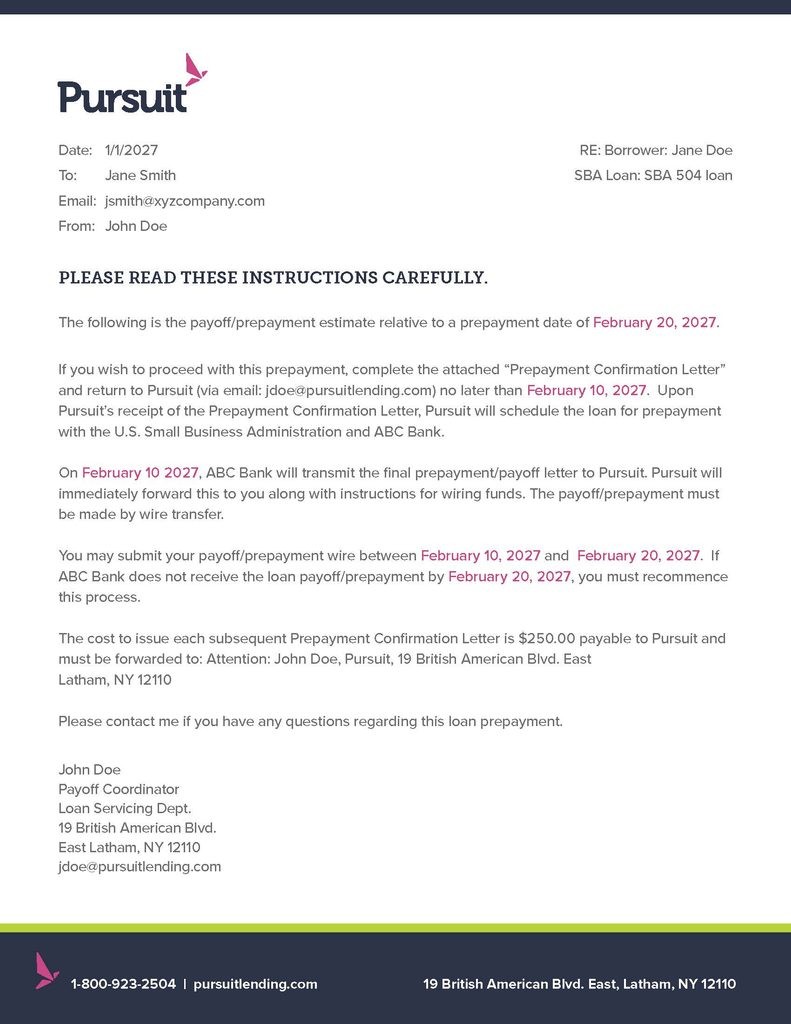
If you’re thinking of paying off your loan early, you’ll need to contact your lender for assistance. There are specific steps that you need to take for this, including a special form that you’ll need to fill out, as well as certain dates you’ll need to make the final payment within, and a specific wire transfer that you’ll need to complete so that your final payoff amount is correct.
It’s also important to know that you may be charged additional fees as a prepayment penalty, depending on your loan agreement. If that’s the case, you’ll want to consider whether paying off the loan early, including the fees, saves you more money compared to the interest you’ll pay if you simply pay off your loan across the full term.
Here’s an example of a loan payoff letter:
Pursuit offers financing that supports small business success
If you need financing to launch the business of your dreams and achieve your goals, Pursuit can help. As a leading small business lender serving businesses across New York, New Jersey, Pennsylvania, Connecticut, Illinois, and Delaware, we offer more than 15 loans and a line of credit tailored to small businesses.
Contact us today to learn more.